
Mastering Clean Architecture in Flutter: A Production-Grade Guide
Category: Flutter ArchitectureReading Time: 8–10 minutesLevel: Intermediate to Advanced Introduction As Flutter applications evolve from small prototy...
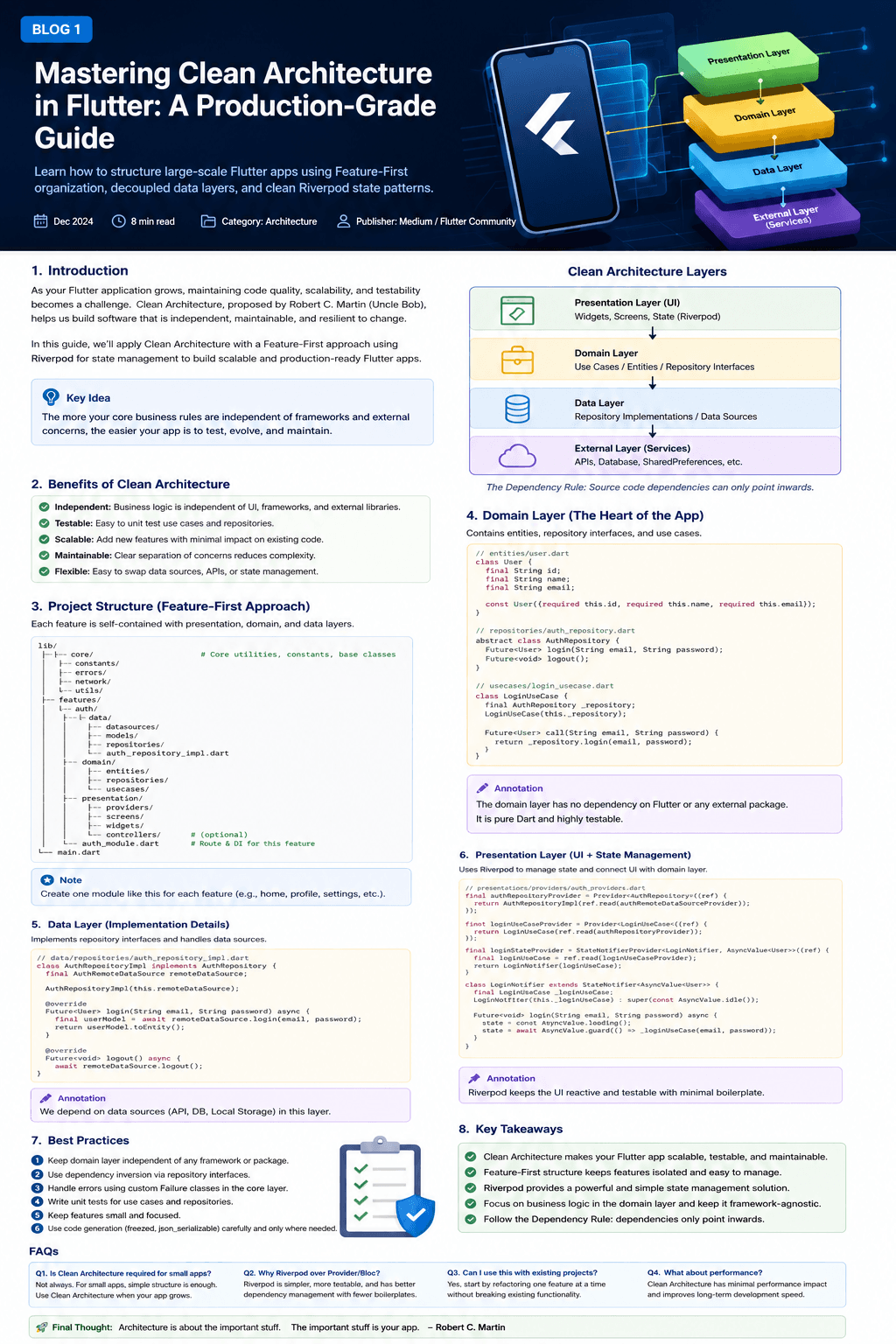
Category: Flutter ArchitectureReading Time: 8–10 minutesLevel: Intermediate to Advanced Introduction As Flutter applications evolve from small prototypes into enterprise-scale products, maintaining a clean, organized, and scalable codebase becomes one of the biggest challenges for development teams. Without a proper architecture, applications often become difficult to maintain, expensive to test, and increasingly fragile as new features are added. Clean Architecture provides a structured approach to software development by separating responsibilities into distinct layers. Each layer has a single responsibility, making the application easier to understand, extend, and test. Whether you're building a fintech app, e-commerce platform, ride-sharing application, healthcare solution, or enterprise dashboard, adopting Clean Architecture can significantly improve long-term maintainability. What is Clean Architecture? Clean Architecture is a software design pattern introduced by Robert C. Martin (Uncle Bob). The primary objective is to separate business logic from frameworks, UI components, and external services. Instead of tightly coupling your application to Flutter widgets, APIs, or databases, Clean Architecture organizes code into independent layers that communicate through abstractions. The central idea is simple: Business rules should not depend on frameworks. Frameworks should depend on business rules. This design allows developers to replace UI frameworks, databases, APIs, or third-party services without rewriting core application logic. Why Should Flutter Developers Use Clean Architecture? Many Flutter applications begin as small projects but quickly expand to dozens of screens, hundreds of API endpoints, and multiple developers working simultaneously. Without architectural boundaries, common problems include: Massive widget files exceeding 1000 lines API calls directly inside UI widgets Duplicate business logic Difficult debugging Low test coverage Tight coupling between modules Clean Architecture eliminates these issues by enforcing clear separation of responsibilities. Benefits include: Better maintainability Easier feature development Improved code readability Independent testing Reusable business logic Scalable project organization Reduced technical debt The Four Core Layers A production-ready Flutter project typically consists of four layers. 1. Presentation Layer The Presentation layer contains everything related to the user interface. Examples include: Screens Widgets Riverpod Providers State Notifiers UI Models Navigation This layer is responsible only for displaying data and handling user interaction. It should never contain: Database queries API calls Business calculations Complex validation logic Instead, it delegates those responsibilities to the Domain layer. 2. Domain Layer The Domain layer is the heart of the application. It contains: Entities Repository Interfaces Business Rules Use Cases This layer knows nothing about Flutter. It should not import: Flutter SDK Dio Firebase SharedPreferences SQLite Instead, it focuses entirely on solving business problems. Example use cases include: Login User Register User Fetch Dashboard Calculate Tax Process Payment Generate Invoice The Domain layer remains stable even if your UI or backend changes. 3. Data Layer The Data layer implements repository interfaces defined inside the Domain layer. Responsibilities include: REST API communication Local database operations Data mapping Cache management Repository implementations This layer interacts with: Dio Hive SQLite Firebase Shared Preferences Secure Storage The Data layer converts raw JSON into domain entities before passing them upward. 4. External Layer The outermost layer contains external frameworks and services. Examples include: REST APIs Firebase Push Notifications Payment Gateways Local Database Analytics Authentication SDKs Replacing one external service with another should not affect your Domain layer. Understanding the Dependency Rule The most important principle of Clean Architecture is the Dependency Rule. Dependencies always point inward. The Presentation layer depends on the Domain layer. The Data layer depends on the Domain layer. The Domain layer depends on nothing. This creates loose coupling and allows each layer to evolve independently. Feature-First Project Structure A Feature-First organization keeps every feature isolated. Example structure: lib/│├── core/│ ├── constants/│ ├── network/│ ├── utils/│ └── errors/│├── shared/│ ├── widgets/│ ├── models/│ └── themes/│├── features/││ ├── auth/│ ││ ├── dashboard/│ ││ ├── profile/│ ││ ├── settings/│ ││ └── notification/│└── main.dart Each feature contains: auth/data/domain/presentation/ This organization prevents unrelated features from depending on one another. Integrating Riverpod Riverpod works exceptionally well with Clean Architecture. Recommended flow: Widget↓ Riverpod Provider↓ Use C
Related Articles
Mastering Clean Architecture in Flutter: The Ultimate Production-Grade Guide (Part 4)
Enterprise Architecture • Performance • Scaling Teams • Best Practices • Interview Questions • Production Checklist Congratulations! If you’ve reached...
Mastering Clean Architecture in Flutter: The Ultimate Production-Grade Guide (Part 3)
Offline-First • Network Layer • Dio • Error Handling • Caching • Testing • Production Best Practices In Part 1, we explored the fundamentals of Clean ...